Some Things Related to Using the Sun for Celestial Navigation
15 Mar 2024
Chuck Varney

In 1991 I wrote a Basic language program, SUNAV.BAS, to calculate sun parameters (GHA, declination, sun semi-diameter, distance from earth, Equation of Time, and time of meridian crossing). I later added a sight reduction portion for celestial navigation sun sights. The latter only requires inputs of date, time, assumed position (AP), and a corrected sextant altitude ( Ho). The sun's geographic position (GP) is calculated by the program.
To illustrate, I ran the program for 30 Nov 22, 1700 UT, AP of 42N 73W, and Ho of 25 degrees--with this result:
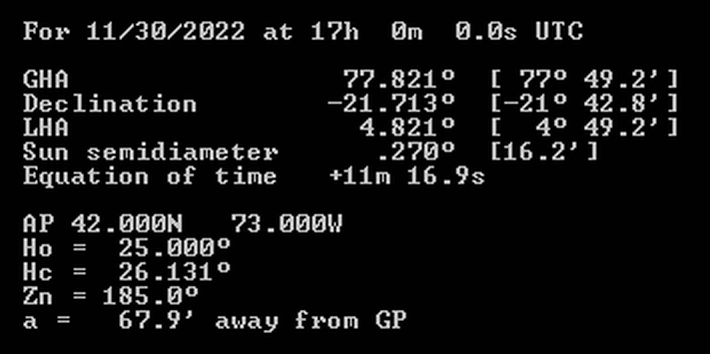
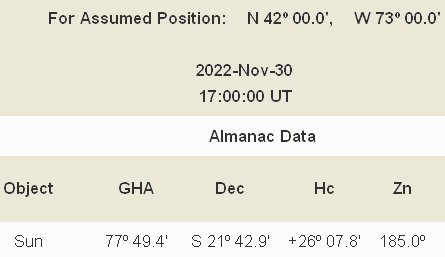
To get a check on the accuracy of the above results for GHA, Dec, Hc and Zn, I used the USNO celestial navigation
data site, https://aa.usno.navy.mil/data/celnav, and compared their almanac data for the sun at the same date, time,
and assumed position that I used above.
The USNO site result is shown below, where the value of Hc in decimal degrees is 26.13:
Comparing USNO results to mine (in parentheses):
GHA 77° 49.4° (77° 49.2')
Dec -21° 42.9' (-21° 42.8')
Hc 26.13° (26.13°)
Zn 185.0° (185.0°)
The GHA and Dec results differ from the USNO site by 0.2' and 0.1', respectively. With my Hc result rounded to two decimal places, the Hc and Zn results are identical.
The sun calculations in SUNAV.BAS are based on the NOTES AND FORMULAE, page C24 in The Astronomical Almanac, 1987, where it stated: "The following formulae give the apparent coordinates of the Sun to a precision of 0.01° and the equation of time to a precision of 0.1 minutes between 1950 and 2050."
In 1992 I compared the SUNAV results for Equation of Time (EoT), declination, and GHA with those in the Nautical Almanac for 1976 (for 6 hours over 4 months) and the Nautical Almanac for 1985 (for 21 hours over 12 months). The maximum difference for EoT was 1 second. The maximum difference for declination and GHA was 0.02° (6 instances)--27 differed by 0.01° and 21 were identical.